
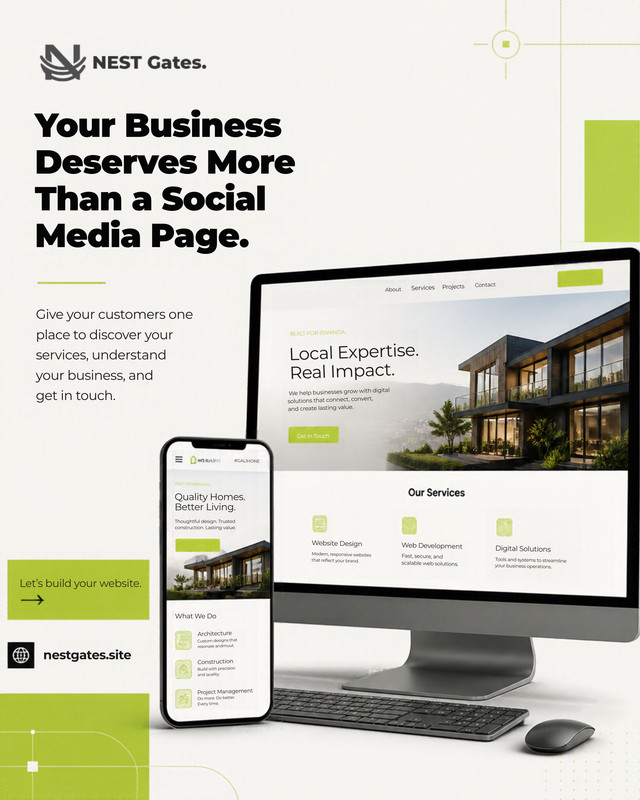
For many small businesses, social media is where their online journey begins.
A Facebook page helps people discover a business. Instagram provides a space to display products and connect with customers. WhatsApp makes conversations and enquiries easier.
These platforms are useful, and businesses should continue using them.
But there is one important question worth asking: If someone wants to understand your business beyond your social media posts, where should they go?
This is where a business website becomes important.
A website gives your business a dedicated online space where people can learn about what you do, explore your services, find important information, and understand how to work with you.
It is more than an online address. When properly planned, it becomes a useful part of how your business communicates with customers.
1. Social media helps people discover you. Your website helps them understand you.
Imagine someone comes across your business on Instagram. They like your products or services and want to know more.
They may have questions:
- What exactly does this business offer?
- Where is it located?
- How can I request a service or make an order?
- Is there more information about the business?
- How can I contact the right person?
Social media can answer some of these questions, but information is often spread across posts, stories, comments, and messages.
A website brings important information together in one organized place.
Visitors can explore your business at their own pace instead of searching through old posts or asking for every detail individually.
That makes the experience easier for both the customer and the business.
2. Your website helps create confidence
Before contacting a business, people often want to understand who they are dealing with.
A professional website can help communicate that clearly.
It can introduce your business, explain your services, display examples of your work, share customer experiences, and provide reliable contact information.
Of course, simply having a website does not automatically make a business trustworthy. The information must be accurate, the design must be clear, and the experience must work properly.
A website should reflect the actual quality and character of the business behind it.
For a small business in Rwanda trying to reach new customers, that first impression can matter.
3. A good website should make things easier for your customers
A website should not exist just because other businesses have one.
It should solve a practical problem.
For example:
- A restaurant may need customers to find its menu, location, and reservation information.
- A school may need parents to access programmes, admission information, and announcements.
- A company offering professional services may need visitors to understand its expertise and request a quotation.
- A shop may want customers to explore its products and find out how to purchase them.
Each business has different needs. Therefore, its website should be planned around those needs.
The important question is not simply, "What should our website look like?"
It is also, "What should visitors be able to do when they arrive?"
4. Your website should work well on mobile phones
A website may look impressive on a computer but become difficult to use on a mobile phone.
That is a problem because many people browse the internet using their phones.
Text should be readable, navigation should be simple, images should display properly, and important buttons should be easy to find and use.
Visitors should not have to zoom in repeatedly or struggle to locate your contact information.
Mobile-friendly design is not an extra decoration. It is an important part of making a website useful.
5. Being online is one thing. Being discoverable is another.
Building a website is an important step, but it does not automatically mean customers will find it through Google or other search engines.
This is where Search Engine Optimization (SEO) becomes relevant.
SEO involves improving a website so that search engines can understand its content and potentially show relevant pages to people searching for related information.
Some important starting points include:
- Writing clear page titles and descriptions.
- Organizing information with meaningful headings.
- Publishing useful and relevant content.
- Making sure important pages can be accessed by search engines.
- Using descriptive links and image descriptions.
- Providing accurate business information.
For a business serving customers in Rwanda, it can also help to communicate clearly about its services and the areas it serves.
SEO is not an overnight process, and no one should promise guaranteed first-page rankings. It takes consistent work, useful information, and a technically sound website.
6. A website does not have to be complicated to be effective
One common misconception is that every business needs a large, expensive website.
That is not necessarily true.
A small business may begin with a few well-organized pages:
- Home: Introduce the business and its main purpose.
- About: Explain who you are and what you stand for.
- Services or Products: Show what customers can get from you.
- Contact: Make it easy for people to reach you.
As the business grows, the website can grow with it.
Additional features such as online payments, booking systems, customer portals, and e-commerce functionality can be introduced when they serve a real need.
The goal should be to build what the business needs, not to add features simply to make the website look bigger.
7. A website needs attention even after it is launched
Launching a website is not the end of the process.
Business information changes. Services are updated. New products are introduced. Technology also requires maintenance.
A useful website should be reviewed regularly to ensure that its information is accurate, its links work, its contact details are current, and its pages continue to provide a good experience.
It is also important to consider security, backups, hosting, and future updates.
A website is part of a business's digital presence, and that presence deserves attention.
So, does your business need a website?
If your customers need a reliable place to understand your business, explore your services, and contact you, a website is worth considering.
Social media and websites do not have to compete. They can support each other.
Social media can introduce people to your business. Your website can give them a clearer picture of what you offer and help them take the next step.
The most important thing is to build with a purpose.
At NEST Gates, we believe digital solutions should begin with understanding people and the needs behind their ideas. Website development is not just about arranging text, images, and colours on a screen. It is about creating an online experience that serves a real purpose.
We work with businesses and organizations to develop useful digital solutions, strengthen their online presence, and bring their ideas to life.
If you are considering a website for your business, start with one question:
What should become easier for my customers once my website exists?
That answer is a good place to begin.
Explore NEST Gates: https://nestgates.site
Building useful digital experiences, one idea at a time.